Observability in iii isn’t something you bolt onto each service. Every cross-worker call already flows through the engine, so the engine can trace and log the whole system end to end. In this chapter you open the console to see that, then, if you want, read the same data directly from the engine.

Open the console

The engine has been running since Chapter 1. Start the console, a browser UI for inspecting it:
iii console
Open it at http://127.0.0.1:3113. Every worker you added is listed with the functions and triggers it registered. Create a link and follow it a few times, and watch the invocations stream in live:
curl -s -X POST http://127.0.0.1:3111/links \
  -H 'Content-Type: application/json' -d '{"url":"https://iii.dev","code":"iii"}'
for n in $(seq 1 5); do curl -s -o /dev/null http://127.0.0.1:3111/s/iii; done
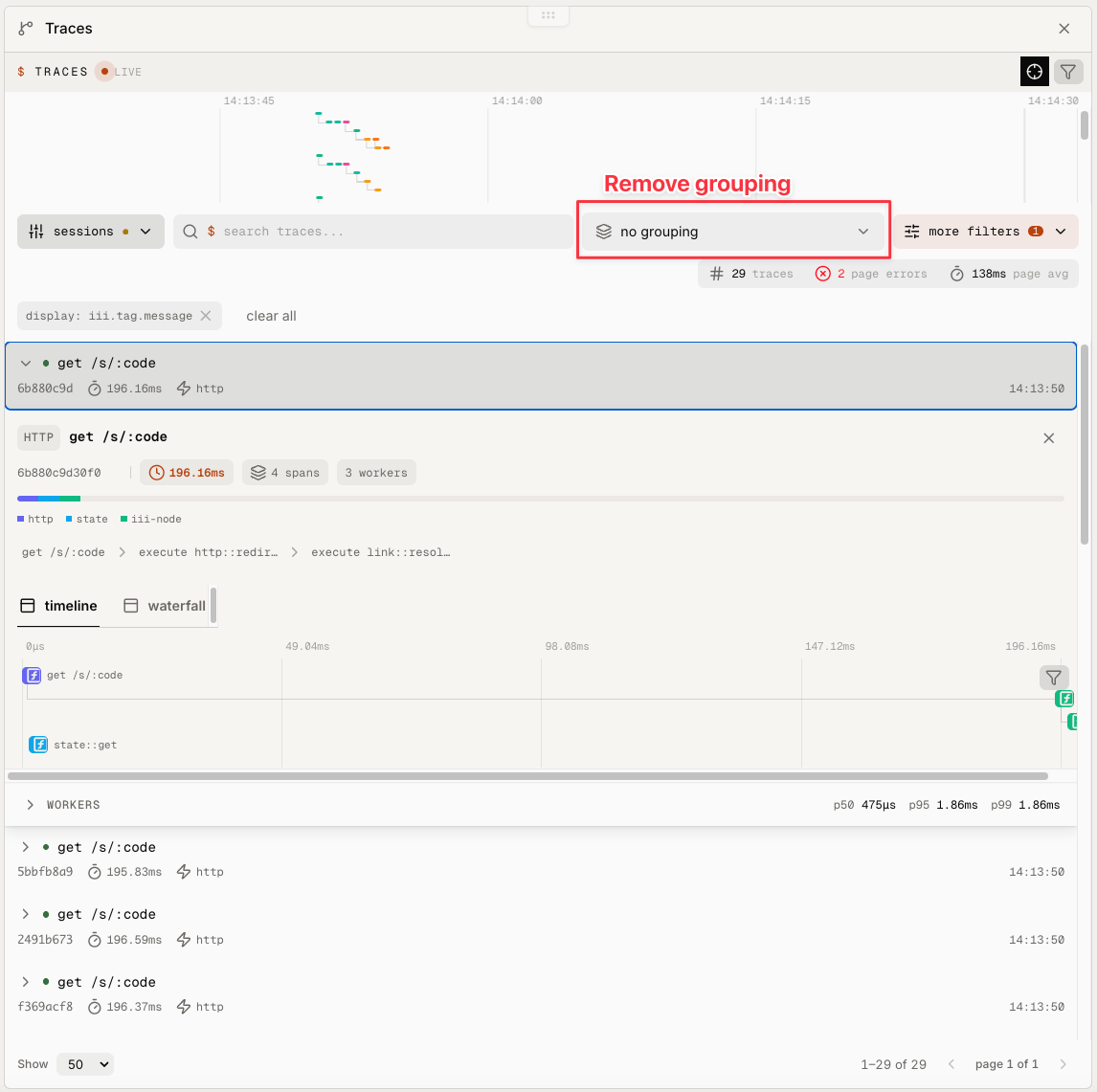
Click any redirect to see a full waterfall of timed spans crossing from iii-http into link and back: iii console Traces page showing redirect spans sorted by duration with the waterfall for a selected GET /s/:code trace You didn’t add a tracing library or thread a request ID between services to get this. iii project init added the iii-observability worker to config.yaml, and from then on every request gets a trace and every Logger line is collected automatically, across workers. That is the point worth pausing on: in iii, end-to-end observability is a property of the system, not a per-service add-on.
iii-observability emits OpenTelemetry. Its traces, metrics, and logs are emitted as OTel, so you aren’t locked into the console. Point the worker at Honeycomb, Grafana, Datadog, or any other OTel-compatible backend and your iii traces flow straight in. See the worker’s configuration on workers.iii.dev/workers/iii-observability.
For most teams the console (or your own OTel backend) is all you need day to day. The rest of this chapter is an optional deep dive: reading the same logs and traces directly from the engine, which is how you’d wire observability into scripts, CI, or an agent.

Use the console

The common path. Watch logs and traces in the console and continue to Chapter 3.

Go deeper

Read on to pull the same logs and traces from the engine with iii trigger.

Log the resolve

link::create already logs. Add a matching line to link::resolve so every lookup is recorded. Edit link/src/index.ts:
src/index.ts
worker.registerFunction("link::resolve", async (payload: { code: string }) => {
  const stored = await worker.trigger<{ scope: string; key: string }, { url: string } | null>({
    function_id: "state::get",
    payload: { scope: "links", key: payload.code },
  });
  logger.info("link resolved", { code: payload.code, found: !!stored?.url });
  return { url: stored?.url ?? null };
});
Save the file (the worker reloads), then drive some traffic:
curl -s -X POST http://127.0.0.1:3111/links \
  -H 'Content-Type: application/json' -d '{"url":"https://iii.dev","code":"iii"}'
for n in $(seq 1 5); do curl -s -o /dev/null http://127.0.0.1:3111/s/iii; done
curl -s -o /dev/null http://127.0.0.1:3111/s/missing

Read the logs

iii trigger engine::logs::list limit=100 \
  | jq '.logs[]
      | select(.body == "link resolved")
      | { body, "log.data": .attributes["log.data"], trace_id, service_name }'
The jq pipe filters the response down to the link resolved entries and keeps the parts that matter for this tutorial, try removing it to see all the information the iii engine can provide.
{
  "body": "link resolved",
  "log.data": { "code": "iii", "found": true },
  "trace_id": "6b20e1fe001742c25bb7dc570b57fe42",
  "service_name": "iii-node"
}
log.data is exactly what you passed to logger.info. The trace_id ties the log to the trace it came from, which is where you look next.

Follow a redirect across workers

Every request is also a trace. Grab the most recent redirect:
iii trigger engine::traces::list name="GET /s/:code" limit=1
Take the trace_id from the result and walk the whole request as a tree:
iii trigger engine::traces::tree trace_id=<trace_id> | jq -r '
  def walk(depth):
    ("  " * depth // "") + .name + " (" + .service_name + ") "
      + (((.end_time_unix_nano - .start_time_unix_nano) / 1e6 * 1000 | round) / 1000 | tostring) + " ms",
    (.children[]? | walk(depth + 1));
  .roots[] | walk(0)
'
The jq pipe walks the nested roots tree, indenting each span by depth and printing its service_name and duration in milliseconds. You get the full path of one redirect, across two workers:
GET /s/:code (iii) 2.32 ms
  call http::redirect (iii) 2.228 ms
    call http::redirect (iii-node) 1.335 ms
      handle_invocation link::resolve (iii) 0.624 ms
        call link::resolve (iii) 0.582 ms
          call link::resolve (iii-node) 0.174 ms
That is the redirect arriving through iii-http, calling http::redirect in link, which calls link::resolve back through the engine. The per-span timing shows where the request spends its time: the view you reach for when a link feels slow.
Worker spans export on a short delay, so a brand-new request’s trace can look truncated for a second or two. Give it a moment, or read a slightly older trace.
To compare many requests, list the redirect spans sorted by duration, slowest first:
iii trigger engine::traces::list name="GET /s/:code" sort_by=duration_ms sort_order=desc limit=10 | jq -c '[.spans[] |
  ((.end_time_unix_nano - .start_time_unix_nano) / 1e6 * 1000 | round / 1000)]'
The slowest redirects rise to the top; open any one’s trace_id with engine::traces::tree to see which hop is responsible.

Conclusion

Linkly is now observable: the console shows every worker, trace, and log as it happens, and you can read the same data from the engine with iii trigger. The links are still kept only in memory, though, so restarting the engine clears them. Next, in Ch. 3: Persist everything, you move them into durable storage.